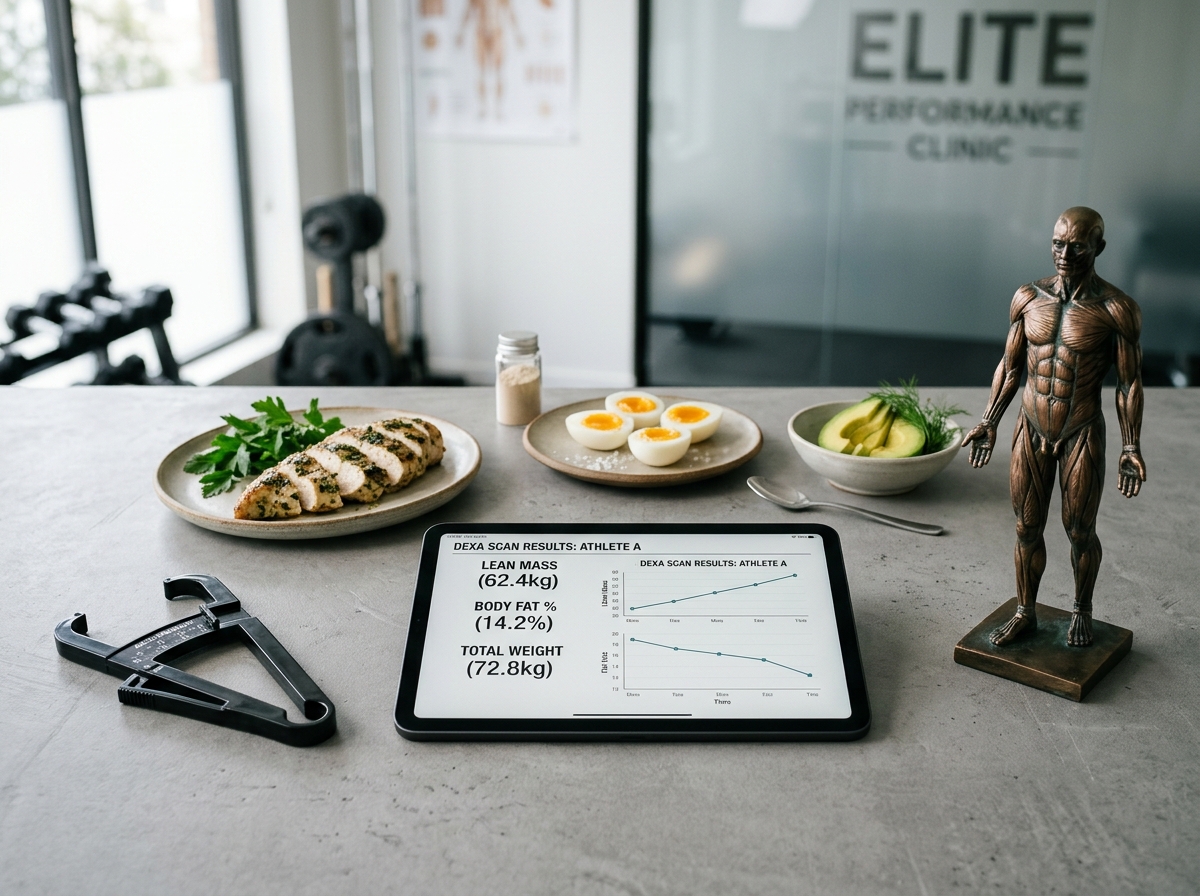
If you have ever tried to get in shape, you have likely been told that you must undergo extreme cyclical phases of "bulking" (eating in a massive calorie surplus to build muscle while accumulating unwanted fat) and "cutting" (eating in an aggressive calorie deficit to lose fat while sacrificing hard-earned muscle). Modern sports exercise metabolism and nutritional science tell a completely different story.
Body recomposition for beginners is the proven physiological protocol of losing stored body fat while simultaneously building lean skeletal muscle mass. Although it requires precise nutritional targets rather than careless dieting, it is the ideal transformation strategy for beginners, individuals returning to resistance training, and especially those struggling with a "skinny-fat" physique (normal BMI but high body fat and low muscular tone).
The Science of Body Recomposition: Why Extreme Bulking and Cutting is Outdated
For decades, gym folklore claimed the human body could only be purely anabolic (building tissue in an energy surplus) or purely catabolic (breaking down tissue in an energy deficit). This oversimplification trapped millions of people in frustrating yo-yo cycles of gaining fat during"dirty bulks" and losing muscle during crash cuts.
Scientific literature now clearly proves why simultaneous fat loss and muscle gain occurs: fat oxidation and muscle protein synthesis are independent, compartmentalized biological pathways. Adipose tissue is essentially stored chemical energy. When placed in a slight calorie deficit with high amino acid availability and progressive mechanical tension, the human body mobilizes calories from stored fat cells to fuel the energy-intensive process of synthesizing new muscle proteins!
Skinny-Fat Body Recomposition for Beginners: Why It Works Best
If you have soft abdominal fat but thin arms and legs, you fall into the"skinny-fat" category. Cutting aggressively on 1,200 calories makes you look emaciated and further depletes muscle. Bulking on 3,000 calories only worsens body fat percentage. Recomposition is the precise solution: you provide just enough fuel and mechanical load to reshape your muscular architecture while systematically leaning out.
The 3 Pillars of Body Recomposition: Deficit Size, Protein Ratios, and Progressive Overload
To orchestrate simultaneous fat loss and muscle growth, you must create the exact biochemical environment. Here is the 3-pillar formula:
The"Goldilocks" Calorie Deficit
Losing fat without being in a calorie deficit is physically impossible. But if you cut your calories too aggressively (500 to 1000 calories less per day), you will trigger your metabolism's alarm bells. Your body, sensing a possible"famine," will almost immediately shut down protein synthesis—an expensive biological function it considers an unnecessary"luxury" in times of crisis.
You must adjust the deficit to a perfect, moderate level: the famous"Goldilocks" calorie deficit. The most effective strategy is to calculate your Total Daily Energy Expenditure (TDEE) and apply a modest cut of just 200 to 300 daily calories (roughly a 10% to 15% deficit). This subtle deficit is enough to promote sustained fat oxidation, but light enough for the body to feel"safe" allowing muscle cellular proliferation.
Hyper-Optimal Protein Intake
Under normal conditions of a caloric surplus, the body is generous with tissue building. But under a deficit, building muscle is swimming against the current. To achieve it, you must oversaturate your body with the fundamental"bricks": amino acids, obtained from the protein you consume.
Multiple clinical trials have corroborated that the standard recommendation for maintenance falls short. To recompose your physique, you need to push intake toward the higher recommended limits, aiming for a range of 0.8 to 1 gram of protein per pound of body weight consistently every day. If you suffer from obesity, you should use your"estimated lean body mass" to make this calculation. Additionally, it is highly advisable to divide this intake across 4 or 5 evenly spaced meals to maximally stimulate the mTOR pathway, which is responsible for hypertrophy.
Relentless Progressive Overload
You could have the perfect calorie deficit and drink hundreds of protein shakes, but if you don't give your muscles a compelling reason to grow, they simply won't. Weight training is the switch that turns on the entire anabolic machinery.
It is not enough to simply"sweat" or"move." You must implement a scheme of progressive overload, which consists of systematically challenging your muscles by forcing them to do more work than they did the previous week. This is achieved by increasing the load (weight), volume (sets and reps), or radically improving your technical execution on multi-joint exercises (squats, overhead press, bench press, pull-ups, and deadlifts). Training with high intensity and taking sets very close to muscle failure (1-2 reps in reserve) is the only way to force your muscles to thicken during a deficit.
The Invisible Fourth Pillar: Sleep and Recovery
While we tend to obsess solely over our macro metrics and our gym volume, actual tissue rebuilding never occurs while we are lifting weights, but rather while we are resting deeply in bed. Sleep is, without a doubt, the most potent natural steroid in existence.
Science has overwhelmingly shown that sleep restriction completely sabotages your efforts. A famous clinical study divided a group of people into a calorie deficit: the first group slept 8.5 hours and the second only 5.5 hours. The astonishing result showed that both groups lost the same amount of weight on the scale, but those who slept poorly lost 55% less fat and 60% more muscle mass compared to those who slept adequately. If you neglect rest, your hormonal environment will collapse: cortisol will rise, testosterone will drop, your hunger will skyrocket (due to ghrelin spikes), and body recomposition will become an unattainable dream.
Who is the Ideal Candidate for Recomposition?
Although advanced athletes and professional competitors have great difficulty gaining muscle in a deficit (because they are close to their natural genetic potential), the vast majority of the normal population will experience spectacular results if they belong to any of these four predominant profiles:
The Absolute Beginner
In the fitness community, this phenomenon is affectionately known as"newbie gains". If you have never systematically touched a weight, your body is extremely sensitive to mechanical stimulus. It will respond to training by adding pounds of muscle at a speed that will never be repeated again in your life, even tolerating large calorie deficits in the process.
The Returning Athlete (Detrained)
Were you in great physical shape, but stopped training due to work, stress, or an injury? You have a huge biological advantage on your side:"muscle memory". The cell nuclei (myonuclei) you formed in the past are still in your fibers, ready to awaken. You can regain all that muscle in record time and burn fat simultaneously with astonishing ease.
People with High Body Fat
Individuals who carry a significant excess of body fat (>25% in men, >35% in women) have immense energy reserves readily available. For this profile, the body does not interpret a sharp calorie deficit as a life-threatening crisis. It will release those fatty acids to build the muscle the person desperately needs.
The Stalled or Sub-optimal Lifter
Have you been going to the gym for three years performing the same 3 exercises with light weight, or consuming barely 50 grams of protein a day? Congratulations: biologically, you are still a beginner. The moment you optimize your routine by introducing aggressive overload and doubling your protein intake, your physique will drastically recompose in a matter of weeks.
Practical Step-by-Step Guide to Start Your Recomposition
Calculate Your Maintenance
Use our calculator to accurately determine your TDEE (Total Daily Energy Expenditure). Be completely honest about your true physical activity level; overestimating it will ruin your results.
Impose the Slight Deficit
From that calculated maintenance number, strictly subtract between 200 and 300 calories. Do not be tempted to restrict more food thinking it will speed up the process. Muscle requires patience.
Set and Protect Your Protein
Aim for a range of 0.8 to 1 gram of protein per pound of body weight. This will be your daily and sacred goal of protein grams. This macronutrient is non-negotiable, hit it daily regardless of the situation.
Adopt a Strength Routine
Abandon the endless cardio sessions and start a proven strength training program 3 or 4 days a week (e.g., Push/Pull/Legs or Upper/Lower routines). Make sure to perform progressive overload in every session.
Measure with Laser Precision
Banish the bathroom scale and rely on the mirror, weekly photos, tape measurements around your waist and chest, and strength increases during your lifts.
The Biggest Mistake: The Bathroom Scale Fallacy
On a psychological level, the deadliest obstacle that destroys body recomposition programs is an unhealthy addiction to the traditional bathroom scale. You must understand a key concept of human physiology: muscle tissue is significantly denser than body fat. To be exact, muscle is approximately 18% more compact. This implies that a pound of muscle takes up much less physical volume than a pound of adiposity.
If you follow the instructions in this guide to the letter, it is a highly likely scenario that, after 4 or 6 full weeks of iron-clad effort and total discipline, you will lose exactly 3 pounds of fat and gain exactly 3 pounds of clean muscle mass. If, after all this work, you step on the scale, you will see a net loss of zero pounds. Your untrained mind will scream"absolute failure!". However, if you evaluate reality objectively, you will have shed an immense layer of soft volume and gained a hard tissue that completely stylizes your figure; you will drop two pants sizes and look phenomenal and athletic in the mirror.
Your New Progress Measurement Kit
- The Body Measuring Tape: Weekly measure the circumference at your navel, hips, thighs, and flexed biceps. A reduction in waist size accompanied by a maintenance or increase in arm perimeter is undeniable confirmation of recomposition.
- Front and Side Photos: Human memory will betray you when looking in the mirror every day. Take identical photos every Sunday first thing in the morning, fasting, and with exactly the same lighting in your room.
- Gym Performance: If you are supposedly eating in a deficit, losing abdominal measurements, and managing to add 10 extra pounds to the squat bar... the muscle is in unquestionable anabolic growth.
Frequently Asked Questions (FAQ)
How long does it take for body recomposition to become visually noticeable?
Body recomposition is a sustainable, balanced process, but undoubtedly slow if you compare it with extreme starvation"miracle diets". You should start noticing notable increases in your strength, vitality, and a better fit in your clothes within the first 4 to 6 weeks. However, the drastic visual changes that surprise you when you look in the mirror and that others begin to strongly notice usually require a minimum commitment of 3 to 6 months of absolute consistency.
Must I do cardio to achieve recomposition?
Chronic intense cardio is not strictly necessary and, in fact, abusing it (like running long marathons) can negatively interfere with muscle growth signaling pathways (the interference effect). However, staying active with NEAT is key. It is strongly recommended to incorporate Low-Intensity Steady State (LISS) cardio, such as an undeniable goal of 8,000 to 10,000 daily steps. This keeps your cardiovascular system healthy and subtly elevates your energy expenditure, allowing you to consume more nutrients while remaining in your strategic deficit.
Should I take supplements to help this process?
Although the foundation should always be solid, whole food and your resistance training, two supplements have Grade A scientific evidence to support recomposition: Whey Protein, which easily and economically facilitates hitting your high daily requirements; and Creatine Monohydrate, which improves high-intensity performance in the gym and increases intramuscular water, thus accelerating and facilitating a greater hypertrophic stimulus during workouts in a deficit.
Sources and further reading
These independent, authoritative sources inform the methods used on this page.
- Campbell, B. I., et al. (2015). International Society of Sports Nutrition position stand: diets and body composition.
- Barakat, C., et al. (2020). Body Recomposition: Can Trained Individuals Build Muscle and Lose Fat at the Same Time?
- Slater, G. J., et al. (2019). Is an Energy Surplus Required to Maximize Skeletal Muscle Hypertrophy Associated With Resistance Training.
Boost Your Results: Suggested Content
The Master Protein Calculator
Calculate how much protein you really need according to your biotype, and optimize muscle synthesis during your body recomposition.
Calculate ProteinTDEE Calculator & Metabolism
Learn step-by-step and with scientific rigor how to estimate your true Total Daily Energy Expenditure (TDEE) to plot your deficit or maintenance target.
Calculate TDEEAre You Ready to Transform Your Body?
Stop trying to guess. Use our free, highly accurate calculator powered by the latest metabolic equations, and get your immovable daily calorie and protein goals in seconds.
Go to Calorie Calculator