
If you have spent even five minutes browsing modern health forums, fitness social media, or supermarket diet books, you have undoubtedly encountered the most persistent nutrition myth of the twenty-first century: the belief that eating carbohydrates automatically makes you fat.
We have been warned that bread is evil, potatoes are toxic, pasta will instantly settle on our hips, and fruit has "too much sugar." In response, millions of well-intentioned people have cut out whole grain cereals, oats, and root vegetables, forcing themselves into chronic ketosis or agonizing low-carb fatigue in the desperate hope of finally shedding unwanted pounds.
Yet despite the cultural ubiquity of low-carb dogma, human evolutionary biology and clinical metabolic research paint a radically different picture. The human body does not view carbohydrates as a biological enemy. In reality, carbohydrates are the body's primary, most oxygen-efficient, and cleanly metabolized energy substrate—superior to dietary fat in virtually every metric of physical output, cognitive clarity, and hormonal resilience.
Let us dismantle the fear-mongering once and for all by examining the precise biochemical mechanisms that govern how your body utilizes, stores, and burns carbohydrates.
Do Carbs Make You Fat or Do Calories? The Physics of Energy Balance
To answer the fundamental question—do carbs make you fat?—we must first consult the First Law of Thermodynamics. Energy within a closed biological system cannot be created or destroyed; it can only be transformed from one state to another.
Inside the human body, adipose tissue (body fat) is an evolutionary savings account. Your body stores surplus energy in adipose fat cells if, and only if, your total energy intake exceeds your total energy expenditure over a sustained period of time. This is commonly termed Calories In vs. Calories Out (CICO).
In a Caloric Deficit
When your total daily energy expenditure (TDEE) exceeds the calories you consume, your body is in an energy shortfall. To keep your heart beating, lungs breathing, and muscles moving, your liver and adipocytes must break down stored triglycerides into free fatty acids. In this state, it is biochemically impossible to gain body fat, regardless of whether 20% or 70% of your diet consists of carbohydrates.
In a Caloric Surplus
When you consistently eat more calories than your body requires, that leftover energy must be stored. However, as human metabolic ward studies prove, it is not the carbohydrate molecules themselves that directly deposit onto your waistline—it is the net excess of energy forcing the storage of co-ingested dietary fats.
The Biochemistry of Fat Storage: How Your Body Actually Handles Excess Carbs
One of the core claims made by anti-carb advocates is that when you eat carbohydrates, insulin levels rise, shutting off fat oxidation and immediately converting all circulating glucose into body fat. This claim represents a profound misunderstanding of human endocrinology and metabolic biochemistry.
When you digest carbohydrates—whether a bowl of oatmeal, a baked potato, or a serving of white rice—enzymes break those starches down into simple glucose molecules. Here is the chronological pathway that glucose takes inside your body:
- Immediate Cellular Oxidation: Circulating glucose is first pulled into brain cells, red blood cells, and vital organs to generate immediate Adenosine Triphosphate (ATP) via glycolysis.
- Glycogen Replenishment: Excess glucose is absorbed by the liver (storing ~80 to 120 grams of glycogen) and skeletal muscles (storing ~350 to 600 grams of glycogen in active adults). This constitutes a massive internal energy buffer of roughly 1,600 to 2,800 calories!
- Up-Regulated Carbohydrate Burning: When your glycogen stores are saturated, your body dramatically increases its rate of carbohydrate oxidation. In other words, the more carbs you eat, the more carbs your body naturally prioritizes burning as heat and kinetic energy.
What About De Novo Lipogenesis (DNL)?
The metabolic process of turning carbohydrates into fatty acids is called De Novo Lipogenesis (DNL). In rodents and livestock, DNL occurs readily. However, decades of clinical isotope studies have demonstrated that in healthy adult humans, DNL is extremely minimal under normal nutritional conditions.
Converting glucose into palmitic acid requires a tortuous multi-step enzymatic pathway that wastes 20% to 25% of the carbohydrate's total caloric value purely as thermic conversion heat! Because your body is an efficient machine, it fiercely resists wasting a quarter of its energy through DNL unless you consume a massive, unnatural surplus of pure carbohydrates (over 500 to 700 grams of pure carbs per day above maintenance) for several consecutive days.
Now contrast this with dietary fat: dietary triglycerides require almost zero chemical modification to be tucked away into adipose cells—a mere 2% to 3% metabolic cost. Therefore, in a real-world hypercaloric meal (such as a burger and fries), your body burns the carbohydrates for energy and directly stores the dietary fat in your adipose tissue. Blaming the carb for the fat gain is like blaming the fire truck for the fire!
The Metabolic Reality: Carbs vs. Dietary Fat (Visual Diagram & Comparison)
To understand why carbohydrates are structurally less prone to direct fat storage than dietary fat, inspect the biological energy costs and metabolic fates depicted in the chart below:
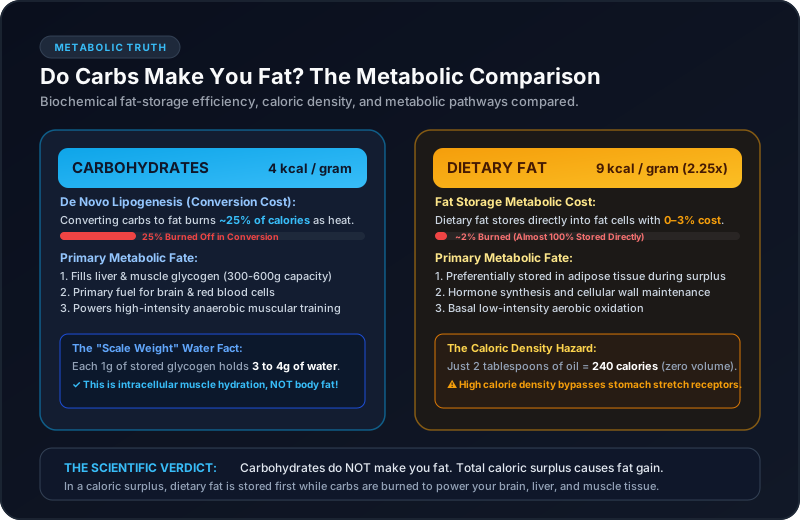
| Metabolic Metric | Carbohydrates | Dietary Fat |
|---|---|---|
| Caloric Density | 4.0 kcal per gram | 9.0 kcal per gram (2.25x higher!) |
| Fat Storage Metabolic Cost | ~20% to 25% burned as heat (inefficient) | ~2% to 3% burned (nearly 100% directly stored) |
| ATP Output per Liter of O₂ | ~5.05 kcal/L O₂ (high efficiency) | ~4.69 kcal/L O₂ (less oxygen-efficient) |
| Brain & RBC Dependency | Obligate fuel (120g/day needed for brain & RBCs) | Cannot be used by red blood cells; non-obligate for brain |
| High-Intensity Workout Fuel | Primary anaerobic glycolytic substrate | Too slow for high-intensity power or heavy resistance sets |
| Water Binding Capacity | 1g glycogen binds 3 to 4g of water | Hydrophobic (zero intracellular water binding) |
Why Carbs Are Actually the Body's Best Macronutrient (Superior to Fat)
While dietary fat is essential for basic hormone synthesis and cellular membrane integrity, carbohydrates hold the biological crown when it comes to human energy optimization, athletic performance, and metabolic vitality. Here is why your body prefers carbohydrates over fats:
1 Superior Cellular Oxygen Efficiency
When your mitochondria burn fuel for energy, they consume oxygen. For every single liter of oxygen your lungs deliver to your bloodstream, carbohydrates yield approximately 5.05 calories of usable energy (ATP), whereas fatty acids yield only 4.69 calories. This means your cardiovascular system, lungs, and muscle cells operate with far greater efficiency when powered by glucose. It is the biological equivalent of running high-octane racing fuel rather than sluggish crude oil.
2 Red Blood Cells and the Brain Require Glucose
Your central nervous system and brain consume roughly 20% of your body's total basal metabolic energy (~120 grams of glucose per day). While the brain can partially adapt to utilizing ketone bodies during severe starvation, glucose remains its preferred and sharpest fuel. More critically, your red blood cells (erythrocytes) have zero mitochondria—they are biologically incapable of metabolizing fats or ketones and depend 100% on glucose for cellular survival.
3 Muscular Power, Glycogen, and Anti-Catabolic Protection
High-intensity resistance training, sprinting, and CrossFit rely almost exclusively on the fast-acting anaerobic glycolytic pathway. When muscle glycogen is depleted, your maximum power output plummets, training volume drops, and perceived exertion skyrockets. Furthermore, carbohydrate intake triggers an insulin response. Far from being a "fat-storing hormone," insulin is the body's most potent anti-catabolic agent—it halts muscle protein breakdown (MPB), preserving lean tissue during fat loss phases.
4 Thyroid Health and Leptin Satiety Signaling
The conversion of inactive thyroid hormone (T4) into the active metabolic hormone (T3) takes place predominantly in the liver and is directly dependent on hepatic glycogen availability and insulin signaling. When people adopt chronic zero-carb or severe keto diets, active T3 levels frequently decline, leading to sluggish thyroid output, feeling constantly cold, elevated cortisol, and impaired sleep quality. Moreover, carbohydrate refeeds stimulate leptin, the master hormone that tells your hypothalamus you are full and satisfied.
The Scale Illusion: Why Do Carbs Make You "Look Fatter" or Gain Weight Fast?
If carbs do not make you fat, why does nearly everyone experience a 3-to-5-pound jump on the scale after eating a large bowl of pasta, a plate of sushi, or a pizza? And why do people rapidly lose 5 pounds during their first week on a low-carb diet?
The answer is simple: intracellular glycogen hydration.
The 1:3 Glycogen-to-Water Rule
For every single 1 gram of carbohydrate stored as glycogen inside your liver and muscle tissue, your body naturally binds and holds 3 to 4 grams of water (H₂O).
If you consume 400 grams of carbohydrates over the weekend to replenish depleted glycogen stores, your body stores that 400g of glycogen alongside roughly 1,200 to 1,600g of water. That totals 1.6 to 2.0 kilograms—or roughly 3.5 to 4.4 pounds of scale weight!
This water is held inside the muscle bellies, giving your physique a full, hydrated, athletic appearance. However, people look at the bathroom scale, see a 4-pound jump after Sunday dinner, and panic: "Carbs make me gain weight instantly!"
Biochemically, gaining 4 pounds of actual adipose tissue requires an energy surplus of approximately 14,000 excess calories above your maintenance burn. Unless you drank two gallons of olive oil over the weekend, that scale fluctuation is 100% temporary water and glycogen. The moment you return to your regular maintenance or deficit calories, that water weight normalizes without leaving a single trace of body fat.
The Ultra-Processed Trap: What Is the "Worst Carb" for Belly Fat?
When people ask, "What's the worst carb for belly fat?" or claim that carbs ruined their health, they are almost never talking about boiled potatoes, steel-cut oats, lentils, or wild blueberries.
Instead, they are pointing fingers at commercial junk foods: frosted donuts, chocolate-covered pastries, double cheeseburgers, potato chips, and deep-dish pizza. But examine the nutritional anatomy of these foods:
Glazed Donut
Total Calories: ~260 kcal
Large French Fries
Total Calories: ~480 kcal
Pepperoni Pizza Slice
Total Calories: ~320 kcal
These foods are not "carbs"—they are hyper-palatable carb-and-fat hybrids designed in corporate food laboratories to bypass the human brain's natural stretch and satiety receptors. When refined carbohydrates, heavy industrial oils, and sodium are combined, the brain's satiety threshold is overwhelmed, causing effortless overconsumption of thousands of excess calories.
In contrast, try overeating plain boiled potatoes, steamed jasmine rice, or fresh apples. An entire pound of boiled potatoes contains only ~390 calories and ranks as the #1 most satiating food on the clinical Holt Satiety Index. It is virtually impossible to become clinically obese eating whole, unprocessed carbohydrates.
Stop Fearing Carbs. Calculate Your Exact Daily Needs.
Whether your goal is rapid fat loss, lean muscle hypertrophy, or athletic endurance, success comes down to your personal energy equation. Use our clinical calculators to determine your maintenance calories, ideal deficit, and customized macronutrient split.
How to Eat Carbs and Lose Fat: The 4-Step Strategy
If you want to maintain high cognitive focus, power through challenging workouts, protect your active thyroid hormones, and melt body fat without starvation, follow these evidence-based guidelines:
Anchor Your Daily Calorie Deficit
Establish a moderate, sustainable caloric deficit of 300 to 500 calories below your maintenance TDEE. This guarantees steady, non-catabolic fat loss of 0.5 to 1.0 pound per week while allowing ample room for dietary carbohydrates.
Lock in Your Protein Target First
Consume 1.6 to 2.2 grams of protein per kilogram of body weight (0.8 to 1.0g per pound). Protein has the highest Thermic Effect of Food (TEF) and protects lean muscle tissue during cutting. (Use our Protein Calculator to get your exact gram target).
Prioritize High-Volume, Fiber-Rich Carbohydrates
Fill 70% to 80% of your carb allotment with nutrient-dense, high-volume sources: oats, sweet potatoes, brown and white rice, quinoa, berries, lentils, and squash. These foods take up substantial space in your stomach, stimulating mechanical stretch receptors that silence hunger.
Time Carbohydrates Around Training
Position a moderate portion of easily digestible carbohydrates 1 to 2 hours before training to saturate blood glucose, and consume another serving post-workout alongside protein. This immediately replenishes depleted glycogen stores and accelerates muscular recovery.
The Bottom Line: Stop Demonizing Carbs
Carbohydrates do not make you fat. Fat gain is the physiological consequence of a chronic caloric surplus, driven predominantly by ultra-processed foods that combine high fats, refined sugars, and high salt.
When eaten within an appropriate caloric framework, carbohydrates fuel high-intensity training, spare your hard-earned muscle tissue, optimize your thyroid and leptin hormones, and power your brain and central nervous system.
Drop the carb-phobia, master your energy balance, and fuel your body with the clean, high-performance energy it was evolved to thrive on.
Scientific References & Clinical Studies
These independent, authoritative sources inform the methods used on this page.
- National Institutes of Health (NIH): Calorie for calorie, dietary fat restriction results in more body fat loss than carbohydrate restriction in people with obesity (PMC4603544)
- American Journal of Clinical Nutrition: De novo lipogenesis in humans during carbohydrate overfeeding and energy balance
- British Dietetic Association (BDA): Carbohydrates and Health Evidence Briefing
- Journal of the International Society of Sports Nutrition (JISSN): International Society of Sports Nutrition position stand: nutrient timing
- Cell Metabolism: A Plant-Based, Low-Fat Diet Decreases Ad libitum Energy Intake Compared to an Animal-Based, Ketogenic Diet (Hall et al.)