
Walk down any grocery aisle or browse fitness social media today, and you will see a bizarre nutritional phenomenon: everything has been injected with extra protein. We now have high-protein cookies, protein water, protein potato chips, and protein pancake syrups.
Online fitness creators routinely boast of consuming 200, 250, or even 300 grams of protein every day. Everyday gym-goers are convinced that if they fail to down an expensive whey shake within twenty minutes of finishing a workout, their muscles will wither away.
Yet when medical researchers, clinical dietitians, and sports scientists examine the data, the conclusion is startlingly unanimous: most people are consuming far more protein than their bodies can biologically use.
Beyond a well-established physiological ceiling, extra protein does not build bigger muscles, burn extra fat, or provide superpowers. Instead, it places unnecessary strain on your digestive tract, creates expensive metabolic waste, and drains your wallet. Let us examine what human biochemistry actually proves about your true daily protein requirements.
How Much Protein Do You Actually Need Daily? (RDA vs. Athletic Reality)
To understand protein requirements, we must first distinguish between the clinical Recommended Dietary Allowance (RDA) and the optimal intake for active individuals.
Sedentary Adults
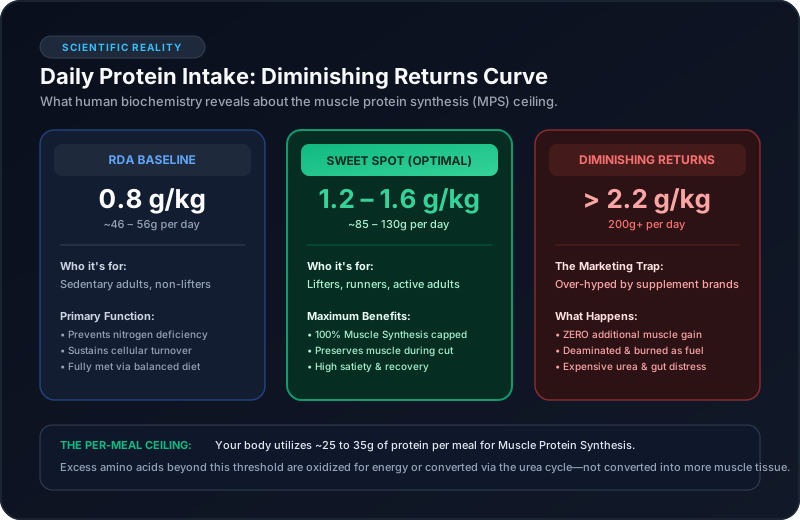
0.8 g/kg
Roughly 46 to 56 grams per day for an average adult. This is the official RDA established by the National Academy of Medicine. It represents the amount necessary to prevent nitrogen deficiency and maintain vital cellular enzyme replacement.
Active Adults & Runners
1.2 – 1.6 g/kg
Roughly 80 to 120 grams per day. Endorsed by the American College of Sports Medicine (ACSM). Powers mitochondrial biogenesis, tissue repair from endurance exercise, and sustained recovery.
Strength & Hypertrophy
1.6 – 2.0 g/kg
Roughly 115 to 150 grams per day. The upper boundary for dedicated natural lifters seeking maximum hypertrophy or preserving muscle during an aggressive calorie deficit.
The Diminishing Returns Curve: Why More Protein Doesn't Mean More Muscle
The human body is an efficient biological machine governed by saturation kinetics. Just as pouring 10 gallons of gasoline into a 5-gallon tank causes an overflow rather than making your car faster, flooding your bloodstream with amino acids beyond your biological repair ceiling does not accelerate muscle growth.
What Actually Drives Muscle Growth?
Protein does not build muscle in isolation; it merely supplies the raw building blocks (amino acids). The biological commander that actually orders new muscle fibers to be constructed is progressive mechanical tension from heavy resistance training.
If you do not subject your muscle fibers to adequate mechanical load, tension, and micro-tears close to muscular failure, your body has zero incentive to synthesize new muscle tissue. Eating 250 grams of protein without intense lifting simply forces your liver to convert those amino acids into blood urea and energy substrates. Training intensity and total energy balance are the true drivers of muscle growth.
The Per-Meal Myth: How Much Protein Can Your Body Use in One Sitting?
Gym lore often claims: "You must eat 50 to 60 grams of protein every two hours to stay anabolic." Conversely, others claim: "Your body can only absorb 30 grams of protein per meal, and anything more is instantly wasted."
Both extremes are scientifically incorrect. To understand the truth, we must separate absorption from utilization for muscle synthesis.
1. Digestive Absorption (Virtually Unlimited)
Your gastrointestinal tract can absorb nearly 100% of the protein you consume. If you eat an 80-gram steak, your stomach and small intestine will slowly release peptides into circulation over 6 to 8 hours. The food does not simply "rot" or exit unabsorbed.
2. The Muscle Protein Synthesis (MPS) Trigger: ~25g to 35g
While your gut absorbs all the amino acids, your skeletal muscle tissue has a distinct ceiling for how much it can use for repair in a single session. This is known as the "Muscle Full" effect. Clinical tracer studies show that approximately 25 to 35 grams of high-quality protein provides between 2.5 and 3.0 grams of the branched-chain amino acid leucine. This amount fully saturates the cellular mTOR pathway.
3. What Happens to the Excess?
Any amino acids ingested beyond the MPS ceiling do not generate extra bicep growth. Instead, they enter the hepatic urea cycle. The liver strips the nitrogen atom off the amino acid (deamination), converting it to urea for excretion by the kidneys. The remaining carbon skeleton is then oxidized for energy or converted via gluconeogenesis. In short: eating an 80-gram protein bowl does not double your muscle growth—it just creates very expensive fuel!
Hidden Risks and Side Effects of Extreme Protein Diets
While healthy individuals can tolerate moderately elevated protein intake, pushing your daily intake to extreme levels (over 2.5g/kg or 200g+ daily) carries distinct physiological risks:
1. Kidney Workload & Filtration Pressure
Every gram of excess protein requires the kidneys to filter nitrogenous waste. In healthy kidneys, this causes adaptive hyperfiltration. However, an estimated 37 million American adults have Chronic Kidney Disease (CKD), and 90% do not know it. For anyone with borderline renal function or a history of calcium oxalate kidney stones, chronic hyper-protein intake accelerates renal decline. (Read our clinical guide on how a low-protein diet protects kidney function in CKD).
2. Saturated Fat & Cardiovascular Risks
When people attempt to consume 200 grams of protein daily without powders, they frequently rely on massive quantities of red meat, bacon, sausages, and processed cheeses. According to the British Heart Foundation and Harvard Health, this dramatically elevates LDL cholesterol, ApoB, and long-term atherosclerosis risk.
3. The Fiber Deficiency Trap (Gut Distress)
When protein crowds out other macronutrients, dietary fiber is almost always the first casualty. Extreme high-protein dieters often experience severe chronic constipation, painful bloating, and altered gut microbiome diversity due to a total lack of prebiotic soluble fiber and resistant starch.
4. Carbohydrate & Hormone Deprivation
Protein is satiating, but your brain, red blood cells, and anaerobic muscle fibers thrive on carbohydrates. As detailed in our guide on why carbs do not make you fat, cutting out carbs to fit in more protein crushes workout intensity, elevates cortisol, and suppresses active T3 thyroid hormones.
Stop Guessing. Find Your Exact Scientifically Proven Protein Target.
Do not let supplement marketing dictate your grocery budget. Use our clinical calculators to discover your personalized protein gram target, total daily energy expenditure (TDEE), and balanced macronutrient split.
Why Is Fitness Media & Gen Z So Obsessed With Protein?
If the human body does not require massive amounts of protein, why has protein become the dominant buzzword of modern dietary culture?
The answer lies in behavioral psychology and corporate marketing:
- The "Health Halo" Effect: In the 1990s, food manufacturers slapped "FAT-FREE" on sugary snacks to make them seem healthy. In the 2020s, the playbook flipped: companies now slap "HIGH PROTEIN" or "20G PROTEIN" on ultra-processed candy bars, pudding cups, and cereals. Consumers perceive the product as virtuous, justifying a 40% to 100% price markup.
- The Illusion of Control: In a world filled with conflicting nutritional advice about carbs, keto, seed oils, and fasting, protein feels like the one "safe" nutrient. People assume that eating more of it is an easy shortcut to looking fit without realizing that muscle gain requires years of progressive strength training.
- Supplement Industry Profits: Whey and plant protein powders have exceptionally high profit margins. Marketing an exaggerated 1-gram-per-pound or 200-gram daily requirement ensures customers finish a $60 tub of protein every two weeks.
Evidence-Based Daily Protein Cheat Sheet
Here is your practical, no-nonsense roadmap based on clinical exercise science rather than supplement advertisements:
| Activity Level / Goal | Grams per Kg (Body Weight) | 70 kg (154 lb) Example | Clinical Takeaway |
|---|---|---|---|
| Sedentary Adult (RDA) | 0.8 g/kg | 56 grams / day | Easily met through regular balanced meals; zero powders required. |
| Recreational Exerciser / Runner | 1.1 – 1.4 g/kg | 77 – 98 grams / day | Supports glycogen recovery and cellular repair without excessive meat. |
| Muscle Building (Hypertrophy) | 1.6 – 1.8 g/kg | 112 – 126 grams / day | 100% of muscle synthesis benefits capped; higher amounts offer no gain. |
| Aggressive Fat Loss Cut | 1.8 – 2.2 g/kg | 126 – 154 grams / day | Protects lean muscle tissue while in a significant caloric deficit. |
| Extreme "Bro-Diet" (200g+) | > 2.5 g/kg | 175 – 220+ grams / day | Diminishing returns; expensive urine; potential digestive distress. |
The Bottom Line: Quality Over Excessive Quantity
Protein is an essential, life-sustaining macronutrient. But like water, vitamins, and oxygen, more is not infinitely better.
You do not need 200 grams of protein to build an athletic, strong physique. If you are lifting weights, aim for a sensible target of 1.6 grams per kilogram (around 0.7 to 0.8 grams per pound). If you are sedentary, 0.8 grams per kilogram is completely sufficient for lifelong health.
Focus on nutrient-dense whole foods—salmon, eggs, Greek yogurt, lentils, beans, and poultry—pair your protein with colorful fiber-rich plants and quality carbohydrates, and stop wasting your hard-earned money on unneeded scoops of powder.
Scientific References & Clinical Studies
These independent, authoritative sources inform the methods used on this page.
- Harvard Health Publishing: When it comes to protein, how much is too much?
- British Journal of Sports Medicine: A systematic review and meta-analysis of protein supplementation on muscle mass and strength (Morton et al.)
- Mayo Clinic Health System: Are you getting too much protein?
- British Heart Foundation (BHF): Protein: how much do you really need?
- Cleveland Clinic Health Essentials: Can You Eat Too Much Protein? Risks and Guidelines