
Every lifter eventually confronts the fundamental biological reality of human physiology: you cannot build substantial new skeletal muscle tissue out of thin air. To synthesize new myofibrillar proteins, repair microscopic cellular tears, and sustain grueling resistance training sessions week after week, your body requires an anabolic surplus of energy.
Unfortunately, fitness culture has historically swung between two disastrous extremes. On one end lies the reckless "dirty bulk"—gorging on fast-food burgers, pizza, and mass-gainer shakes under the delusion that rapid scale weight equals rapid muscle growth. The predictable result? A fluffy waistline, elevated blood pressure, insulin resistance, and a depressing 6-month cut that burns away the very muscle you attempted to build.
On the opposite end lies "hyper-cautious maingaining"—eating at exact maintenance out of terror of gaining an ounce of fat. For anyone beyond their first three months of lifting, this locks you into perpetual stagnation: lifting the same weights, looking identical year after year, and frustrating your genetic potential.
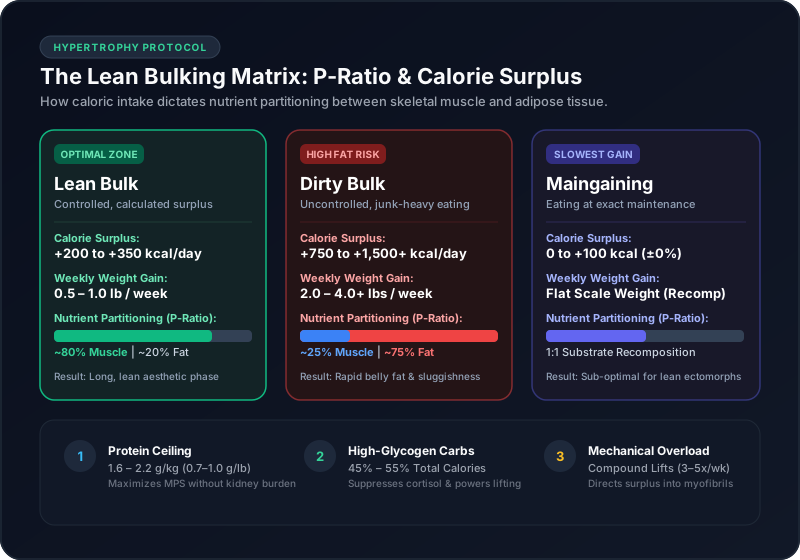
The golden path between these extremes is the Lean Bulk (also termed a clean bulk). By engineering a precise, modest caloric surplus (+200 to +350 calories above your maintenance baseline) and coupling it with progressive overload, you maximize your body's biological rate of muscle growth while holding adipose fat accumulation to an absolute minimum.
Lean Bulk vs. Dirty Bulk vs. Maingaining: The Head-to-Head Comparison
To understand why the lean bulk dominates modern sports science, examine how each nutritional protocol influences rate of gain, hormonal health, and real-world body composition:
| Strategy | Daily Calorie Surplus | Weekly Weight Gain Target | Composition of Gained Weight | Subsequent Cut Required |
|---|---|---|---|---|
| Lean Bulk (Recommended) | +200 to +350 kcal (+5% to +10%) | 0.5 to 1.0 lb (Beginner) 0.25 to 0.5 lb (Intermediate) | ~75% to 85% Lean Muscle ~15% to 25% Adipose Fat | Minimal (Brief 3–4 week mini-cut) |
| Dirty Bulk | +750 to +1,500+ kcal (+25% to +40%) | 2.0 to 4.0+ lbs per week | ~20% to 30% Muscle ~70% to 80% Adipose Fat | Agonizing (4–6 months of aggressive cutting) |
| Maingaining (Recomp) | 0 to +100 kcal (Exact Maintenance) | Flat scale weight (0.0 lb/wk) | Slow local recomposition | None (Risk of prolonged plateaus) |
The Bioenergetics of Muscle Gain: The P-Ratio Secret
Why does eating an extra 1,000 calories not build muscle four times faster than eating an extra 250 calories? The answer lies in the human body's biological ceiling for protein synthesis and a physiological concept known as the P-Ratio (Nutrient Partitioning Ratio), pioneered by Dr. Gilbert Forbes.
Your P-Ratio dictates what fraction of excess dietary energy is partitioned toward fat-free lean mass (protein accretion) versus adipose tissue (lipid storage).
The Caloric Cost of Tissue Accretion
- • Building 1 lb of skeletal muscle: Requires approximately 2,500 to 2,800 kcal of energy. Muscle tissue is roughly 70% water, 20% protein, and 10% glycogen/intracellular minerals. The energy is consumed by the biochemical work of messenger RNA translation, peptide chain assembly, and cellular remodeling.
- • Storing 1 lb of adipose body fat: Requires roughly 3,500 kcal of surplus energy. Adipose tissue is highly concentrated lipid droplets with virtually zero metabolic cost to store.
Because a natural lifter can physically synthesize at most 20 to 50 grams of new muscle tissue per day under optimal conditions, providing 1,000 surplus calories creates an energy spillover. Your muscle protein machinery maxes out; every remaining calorie is diverted straight to your adipocytes (fat cells).
Step-by-Step: How to Calculate Your Exact Lean Bulking Calories
To execute a flawless lean bulk, you must not guess your intake. Follow this three-step clinical formula:
Find True Maintenance (TDEE)
Determine your Total Daily Energy Expenditure by inputting your age, height, weight, and activity multiplier into our clinical TDEE Calculator. For most active adults, maintenance falls between 2,200 and 2,800 kcal/day.
Apply the Anabolic Surplus
Add an exact surplus based on your experience level:
• Beginners / Hardgainers: Add +300 to +350 kcal (+10% to +15%).
• Intermediates: Add +200 to +250 kcal (+5% to +8%).
• Advanced: Add +150 to +200 kcal (+5%).
Track 14-Day Moving Average
Weigh yourself daily first thing in the morning after using the bathroom. Calculate your weekly average. Ignore daily fluctuations; if your weekly average is increasing by 0.5 to 1.0 lb, your surplus is dialed in perfectly.
Want to skip manual math and get your exact personalized numbers?
The Rate-of-Gain Matrix: Exactly How Fast to Gain Weight
The single most common mistake lifters make during a bulk is tracking scale weight without respecting the biological rate of human muscle growth. As established in sports science models by Lyle McDonald and Alan Aragon, natural muscle building potential decelerates drastically as you gain training experience:
| Training Experience | Target Rate of Weight Gain (Weekly) | Monthly Weight Target | Expected True Muscle vs. Fat Ratio |
|---|---|---|---|
| Year 1 Beginner (Novice Lifter) | 0.5 to 1.0 lb (0.25 to 0.45 kg) | 2.0 to 4.0 lbs / month (~1.5% body weight) | ~80% Muscle / ~20% Fat |
| Years 2–3 (Intermediate Lifter) | 0.25 to 0.5 lb (0.12 to 0.25 kg) | 1.0 to 2.0 lbs / month (~1.0% body weight) | ~65% Muscle / ~35% Fat |
| Years 4+ (Advanced Lifter) | < 0.25 lb (< 0.1 kg) | 0.5 to 1.0 lb / month (~0.25% to 0.5% body weight) | ~50% Muscle / ~50% Fat |
*If you are an intermediate gaining 4 pounds a month, at least 2.5 to 3 of those pounds are pure adipose tissue. Dial your surplus back immediately by 150 calories to avoid premature fat gain.
The Lean Bulking Macro Architecture: Protein, Carbs & Fats
Meeting your caloric surplus is only half the battle; how you distribute those calories across the three macronutrients dictates workout performance, hormonal signaling, and recovery kinetics:
1. Protein: The 1.6 to 2.2 g/kg Ceiling
20% – 25% CaloriesThe fitness industry insists on 1.5 to 2.0 grams per pound (3.3 to 4.4 g/kg), but modern sports nutrition disproves this myth. In our clinical analysis on why a lot of protein is not necessary, data from over 49 randomized controlled trials demonstrates that muscle protein synthesis tops out at 1.62 g/kg (0.73 g/lb), with 2.2 g/kg serving as a safe upper ceiling for hard-training athletes.
For an 80 kg (176 lb) lifter, your daily protein requirement is 130 to 175 grams. Spreading this across 3 to 5 meals with 30 to 45 grams per meal maximizes leucine-triggered mTOR activation throughout the day.
2. Carbohydrates: The High-Glycogen Anabolic Engine
45% – 55% CaloriesCarbohydrates are the true unsung heroes of a successful lean bulk. Despite low-carb dogmas, our evidence-backed guide on why carbs do not make you fat explains that dietary carbohydrates replenish intramuscular glycogen, fuel high-tension resistance training, suppress catabolic cortisol, and elevate active T3 thyroid hormones.
Aim for 4.0 to 7.0 grams of carbohydrates per kilogram of body weight (roughly 350 to 500 grams per day for a standard 3,000-calorie bulk) from clean sources like jasmine rice, oats, sweet potatoes, bananas, and whole-wheat pasta.
3. Dietary Fats: The Hormonal Floor
20% – 25% CaloriesFats are critical for steroid hormone synthesis (including testosterone and growth factors) and fat-soluble vitamin absorption (A, D, E, K). However, because dietary fats require virtually zero energy to convert into adipose tissue (possessing a Thermic Effect of Food of only 0% to 3%), overeating fat during a bulk easily accelerates fat gain.
Maintain your fats at 0.7 to 1.0 gram per kilogram of body weight (typically 60 to 80 grams daily) prioritized from monounsaturated and polyunsaturated sources: extra virgin olive oil, whole eggs, avocados, almonds, and natural peanut butter.
The "Skinny-Fat" Protocol: Should You Bulk or Cut First?
One of the highest-volume search queries in bodybuilding is "lean bulk for skinny fat". Skinny-fat individuals carry high visceral/belly fat percentages while lacking muscular frame development in their chest, back, and shoulders.
If you jump straight into a dirty bulk while skinny-fat, your existing poor insulin sensitivity and higher aromatase enzyme activity will channel up to 80% of excess calories directly to your waistline, worsening your physique. Use this decision roadmap:
Cut First (Body Recomposition)
Do not enter a caloric surplus. Instead, consume a slight 10% to 15% calorie deficit (roughly 300 to 500 kcal below maintenance) using our Calorie Deficit Calculator while eating high protein (2.0 g/kg) and lifting heavy.
Because you are untrained, your body will readily burn stored abdominal fat to fuel muscle hypertrophy. Once you hit 12% to 14% body fat, you can safely transition to a lean bulk.
Begin a Micro-Surplus Lean Bulk
If your ribs are visible and your waist is narrow, do not starve yourself. Initiate a very conservative +200 kcal lean bulk. Focus 100% of your energy on adding weight to compound lifts (squats, bench press, overhead press, pull-ups).
Building 8 to 10 pounds of dense contractile muscle tissue will stretch out your skin, widen your shoulders, and completely eliminate the skinny-fat appearance.
The Budget Lean Bulking Shopping List: High Calories on a Budget
Building muscle does not require ₹10,000 / $200 weekly grocery bills. The most effective clean bulking foods are humble, whole-food staples with high caloric density and low satiety per dollar:
Complex Carbs (Fuel)
- • Rolled Oats: Cheap, soluble fiber, easy to blend into smoothies.
- • White & Brown Rice: Low-cost, fast digestion, zero bloating.
- • Bananas & Dates: Rapid potassium-rich glycogen restoration.
- • Potatoes & Sweet Potatoes: Micronutrient-dense potassium bomb.
- • Whole-Wheat Pasta: High caloric density for hardgainers.
Quality Proteins (Repair)
- • Eggs & Egg Whites: Perfect biological value and choline.
- • Canned Tuna & Sardines: High protein, low fat, rich in omega-3s.
- • Chicken Breast & Thighs: High leucine content for mTOR.
- • Greek Yogurt & Cottage Cheese: Slow-digesting casein.
- • Lentils, Chickpeas & Tofu: High-fiber budget plant protein.
Healthy Fats (Hormones)
- • Natural Peanut Butter: 190 kcal per 2 tbsp, incredible cost/cal ratio.
- • Extra Virgin Olive Oil: Healthy monounsaturated fats.
- • Chia & Flax Seeds: Omega-3 ALA and digestive fiber.
- • Raw Almonds & Walnuts: Calorie-dense snack on the go.
- • Dark Chocolate (85%+): Flavonoid antioxidants and magnesium.
Sample 1-Day 3,000-Calorie Lean Bulking Meal Plan
Here is an exact, science-backed 3,000-calorie daily meal schedule engineered for an 75–85 kg lifter, providing approximately 175g Protein (23%), 410g Carbs (55%), and 73g Fat (22%):
100g rolled oats cooked with water, 1 scoop (30g) whey or pea protein powder stirred in, 1 large banana sliced, 2 tablespoons natural peanut butter, and 1 teaspoon honey.
Vegetarian / Vegan Option: Use plant-based pea/rice protein powder and almond milk.
180g grilled chicken breast (or 200g grilled tofu/tempeh), 1.5 cups cooked jasmine white rice, 1 cup steamed broccoli and bell peppers, and 1 tablespoon extra virgin olive oil drizzled on top.
Indian / Vegetarian Option: 150g low-fat paneer or 200g spiced chickpea curry (chole) with 1.5 cups jeera rice.
200g non-fat plain Greek yogurt (or soy skyr), 1 cup fresh blueberries, 30g raw crushed almonds, and 2 Medjool dates for rapid glycogen replenishment before or after your lifting session.
170g baked salmon fillet (or lean 93/7 ground turkey), 1 large baked sweet potato (approx. 250g), 1/4 avocado sliced, and a mixed green salad with balsamic vinaigrette.
Vegetarian Option: 1.5 cups yellow lentil dal with 2 whole-wheat rotis and 100g sautéed paneer cubes.
150g cottage cheese (rich in slow-release micellar casein protein) or a warm cup of fortified almond milk with 1 tablespoon crushed walnuts.
The Two Non-Negotiable Catalysts: Heavy Lifting & Sleep
A calorie surplus is merely raw material; without a strong biochemical signal commanding your cells to build muscle, surplus calories will simply be stored as body fat. Two factors dictate whether that command is executed:
1. Progressive Mechanical Tension
You must train with intense, progressive resistance training 3 to 5 days per week. Prioritize multi-joint compound movements (barbell squats, deadlifts, bench presses, overhead presses, barbell rows, and weighted pull-ups). You must train within 1 to 3 repetitions of muscular failure (RPE 7–9) and progressively add weight or repetitions over time.
2. The 8-Hour Sleep Rule
In a landmark clinical study published in the Annals of Internal Medicine, researchers found that sleeping 5.5 hours versus 8.5 hours shifted nutrient partitioning drastically: the sleep-deprived group lost 60% more muscle tissue and stored more body fat under identical caloric conditions. Sleep is when human growth hormone (HGH) peaks and muscle tissue repair takes place. Prioritize 7 to 9 hours nightly.
The Bottom Line
Building an impressive, muscular, athletic physique is a marathon of consistency, not an eating contest. Forget the outdated dirty bulks that ruin your waistline and leave you with months of grueling cuts.
Establish your true maintenance with our TDEE Calculator, add a clean +200 to +350 calorie surplus, lock in 1.6 to 2.2 g/kg of protein with high-glycogen carbohydrates, train hard with progressive overload, and trust the process for 6 to 9 months.
Sources and further reading
These independent, authoritative sources inform the methods used on this page.
- Morton et al. (2018): Systematic Review and Meta-Analysis of Protein Intake on Resistance Training Hypertrophy (British Journal of Sports Medicine)
- Helms et al. (2014): Evidence-Based Recommendations for Natural Bodybuilding Contest Preparation: Nutrition and Supplementation (JISSN)
- Schoenfeld, B. J. et al. (2017): Dose-Response Relationship Between Weekly Resistance Training Volume and Muscle Mass Gains (Journal of Sports Sciences)
- Forbes, G. B. (1987): Human Body Composition: Growth, Aging, Nutrition, and Activity (Nutrient Partitioning and P-Ratio Foundations)
- Nedeltcheva, A. V. et al. (2010): Insufficient Sleep Undermines Dietary Efforts to Reduce Adiposity and Shifts Nutrient Partitioning (Annals of Internal Medicine)