
Clinical Nutrition Review: This guide evaluates human metabolic pathways, dietary thermogenesis (TEF), endocrine signaling, and sports performance science in accordance with sports dietetics standards (2026).
The 4-Calorie Paradox: Laboratory Bomb Calorimetry vs. Human Metabolism
Look at any nutrition facts label in the grocery store, and the standard arithmetic is identical: every single gram of protein yields 4 calories, and every single gram of carbohydrate yields 4 calories. This metric stems from the 19th-century Atwater energy system, developed by chemist Wilbur Olin Atwater by burning dried food samples inside a pressurized bomb calorimeter.
In a stainless-steel combustion chamber, protein and carbohydrates produce an identical thermal explosion of heat energy. However, the human digestive tract is not an industrial furnace. When you chew, swallow, and assimilate nutrients, your body undergoes complex, multi-step enzymatic cascades that consume substantial metabolic energy.
The gross energy written on the package is not the net metabolizable energy your body actually keeps. Once you factor in the metabolic cost of digestion, cellular assimilation, and hepatic processing, the biological reality looks completely different:
Net Energy: ~2.8 to 3.2 kcal/g
Between 20% and 30% of the caloric value of protein is immediately dissipated as thermal heat during digestion, peptide cleavage, and urea synthesis. Eating 100 kcal of protein leaves your body with only 70 to 80 usable calories.
Net Energy: ~3.6 to 3.8 kcal/g
Only 5% to 10% of carbohydrate calories are consumed during digestion and glycogen storage. Eating 100 kcal of digestible carbs delivers 90 to 95 usable calories directly into circulation as blood glucose.
Head-to-Head Comparison: Protein vs. Carbohydrates (Visual Comparison Diagram)
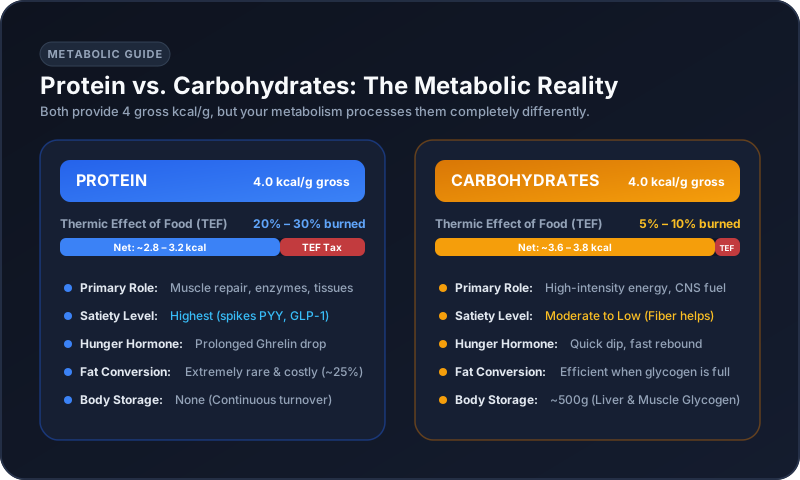
To understand whether to prioritize protein or carbs, examine their structural and metabolic profiles side by side:
| Feature | Protein (Polypeptides) | Carbohydrates (Saccharides) |
|---|---|---|
| Gross Caloric Density | 4.0 kcal per gram | 4.0 kcal per gram |
| Thermic Effect (TEF) | 20% – 30% (Very High) | 5% – 10% (Low to Moderate) |
| Net Usable Calories | ~2.8 – 3.2 kcal/g | ~3.6 – 3.8 kcal/g |
| Primary Biological Function | Cellular repair, muscle protein synthesis, enzymes, immunoglobulins | Primary rapid energy substrate (glycogen & ATP generation) |
| Storage Capacity in Body | None (Transient amino acid pool in blood & muscle tissue) | ~400–600g total (Liver glycogen ~100g, Muscle ~400–500g) |
| Impact on Satiety Hormones | Dramatically raises PYY, GLP-1, and CCK; blunts Ghrelin | Transient fullness; can cause reactive hunger if refined |
| Insulin Secretion | Moderate, accompanied by Glucagon release | High to Moderate (dose and glycemic index dependent) |
| Essentiality in Diet | Essential (9 Essential Amino Acids cannot be synthesized) | Non-essential (Body can synthesize glucose via gluconeogenesis) |
Why Protein Has a Built-In "Metabolic Discount"
The Thermic Effect of Food (TEF) represents the caloric expenditure necessary to break peptide bonds, absorb amino acids via active sodium-dependent transporters, and process nitrogenous waste through the ornithine urea cycle in the liver.
When you consume 500 calories of grilled chicken breast (approximately 125 grams of protein):
- Your metabolism immediately spends 100 to 150 calories just executing the enzymatic breakdown and protein synthesis machinery.
- Your net energetic yield is only 350 to 400 calories.
Conversely, when you consume 500 calories of white rice or pasta (approximately 125 grams of carbohydrates):
- Your salivary and pancreatic amylase quickly cleaves starches into glucose monomers with minimal thermodynamic resistance, expending only 25 to 50 calories.
- Your net energetic yield is 450 to 475 calories.
Over a 12-week fat loss phase, this metabolic discrepancy compounds significantly. Consuming an extra 40 grams of daily protein in place of 40 grams of refined carbohydrates can automatically burn an extra 3,000 to 4,500 net calories through TEF alone—without adding a single extra minute of cardio.
Satiety Dynamics: Why Protein Crushes Cravings Better Than Carbs
Appetite is governed by a precise neurochemical cross-talk between the stomach, pancreas, intestines, and the hypothalamus in your brain. In clinical trials, protein repeatedly outperforms carbohydrates and dietary fats for subjective satiety and involuntary calorie restriction.
Here is why high-protein meals keep you full for 4 to 6 hours, while high-carb meals often leave you hunting for snacks within 90 minutes:
1. Gastrointestinal Hormone Release (PYY, GLP-1, and CCK)
When intact proteins and polypeptides reach the duodenum and ileum, enteroendocrine L-cells trigger the immediate secretion of Peptide YY (PYY) and Glucagon-Like Peptide-1 (GLP-1). These potent anorexigenic hormones slow gastric motility (the speed at which food exits your stomach) and send powerful satiety signals directly to the arcuate nucleus in the brain.
2. Sustained Ghrelin Suppression
Ghrelin is your body's primary orexigenic (hunger-stimulating) hormone, secreted primarily by fundic cells in the stomach. While carbohydrates cause an immediate, steep dip in ghrelin, levels rebound aggressively within 2 hours. Protein produces a deeper, significantly more prolonged suppression of circulating ghrelin, preventing postprandial hunger spikes.
3. The Blood Sugar Rollercoaster (Glycemic Fluctuations)
When you ingest fast-digesting carbohydrates without adequate protein or fiber, glucose enters the bloodstream rapidly. The pancreas responds by flooding the circulation with insulin to shuttle glucose into cells. In many individuals, this creates a temporary "reactive hypoglycemia" (a sudden drop in circulating blood sugar), triggering physiological cravings for fast-acting sugar to restore balance.
Want to Find Your Ideal Daily Protein Target?
Use our clinical Protein Calculator to find your exact grams and calories based on your body weight, activity level, and goals.
Energy Delivery: Why You Still Need Carbohydrates
Given protein's superiority for metabolic burn and appetite suppression, you might wonder: Why not replace all carbohydrates with protein?
While low-carb and ketogenic diets are effective for certain populations, completely eliminating carbohydrates handicaps exercise intensity, muscular recovery, and athletic endurance. Contrary to persistent diet culture myths, carbs do not inherently make you fat—they are your neuromuscular system's ultimate high-octane fuel.
1. Muscle Glycogen: The Fuel for Anaerobic Power
Intense weightlifting, sprinting, and high-intensity interval training (HIIT) rely almost exclusively on the anaerobic glycolytic energy system. When you contract a muscle against heavy resistance (above 70% of your 1-rep maximum), your cells cannot oxidize fatty acids or amino acids fast enough to resynthesize Adenosine Triphosphate (ATP). They demand stored intracellular muscle glycogen.
If your glycogen stores are chronically depleted due to severe carbohydrate restriction, your power output, barbell velocity, and total repetitions drop precipitously. Over time, diminished training volume blunts mechanical tension—the number one driver of muscle hypertrophy.
2. The "Protein-Sparing" Effect of Carbohydrates
When you consume adequate carbohydrates, your body uses circulating glucose and stored glycogen for daily physical energy demands. This frees up dietary amino acids to perform their true, irreplaceable job: structural tissue repair, immune function, and muscle protein synthesis (MPS).
In the absence of sufficient dietary carbohydrates or fats, your liver is forced to convert valuable amino acids into glucose via gluconeogenesis. Burning expensive, muscle-building protein as an energy source is an inefficient metabolic compromise.
Protein vs. Carbs: Which Wins for Your Specific Goal?
The Winner: Protein (Supported by Fiber-Rich Carbs)
During a caloric deficit, your risk of catabolic muscle wasting skyrockets. Elevating protein to 1.8 to 2.4 grams per kilogram of body weight (0.8 to 1.1 g/lb) maintains positive nitrogen balance, shields lean muscle mass, and keeps hunger manageable.
Carb Strategy: Don't eliminate carbs entirely. Moderate carbs (1.5 to 3.0 g/kg) centered around your training window keep workouts explosive and thyroid hormones (T3) functioning normally.
The Winner: A Synergistic Partnership
When aiming to build maximum muscle in a calorie surplus, protein provides the raw amino acid bricks (specifically the leucine trigger), while carbohydrates supply the energetic mortar.
Carb Strategy: Once protein is locked in at 1.6 to 2.0 g/kg, allocating remaining surplus calories primarily to complex carbohydrates (4 to 7 g/kg) drives cellular hydration, maximizes glycogen supercompensation, and fuels higher training volume (remember: eating more protein beyond this threshold yields diminishing returns).
Nutrient Timing: How to Combine Protein and Carbs Around Workouts
While total daily macronutrient intake accounts for 80% of your body composition success, strategically pairing protein and carbohydrates around your training session enhances acute recovery and performance:
Pre-Workout (1 to 2 Hours Before Training)
- Carbohydrates (30g – 60g): Consume moderate-to-low glycemic carbohydrates (e.g., oats, bananas, sweet potatoes, whole grain toast) to provide sustained bloodstream glucose without digestive distress.
- Protein (20g – 30g): Include a lean, low-fat protein source (e.g., whey isolate, egg whites, Greek yogurt) to elevate plasma amino acid levels during the workout, blunting muscle breakdown.
Post-Workout (Within 2 Hours After Training)
- Protein (25g – 40g): Ingest a high-quality, leucine-rich protein source to trigger the intracellular mTORC1 pathway and maximize Muscle Protein Synthesis.
- Carbohydrates (40g – 80g): Consuming fast-digesting carbohydrates replenishes depleted muscle glycogen and triggers an insulin response that aids nutrient delivery into muscle cells.
Recommended Protein-to-Carb Ratios by Lifestyle
How should you structure your daily macro distribution? Use these evidence-based starting frameworks, which you can easily customize with our Beginner Macro Guide:
Higher Protein, Lower Carb
40% P / 25% C / 35% F
Prioritizes aggressive hunger suppression, insulin sensitivity, and high thermic burn for non-athletes.
Balanced Recomp Ratio
30% P / 45% C / 25% F
The gold standard for lifters seeking simultaneous fat loss and muscle retention without sacrificing gym strength.
High Carb, Moderate Protein
20% P / 55% C / 25% F
Provides the massive glycogen replenishment required by runners, cyclists, and team-sport athletes.
Stop Guessing Your Macros. Start Calculating.
Don't leave your nutrition to generic rules of thumb. Calculate your personalized calorie baseline, exact protein target, and balanced macro split in less than 30 seconds.
Scientific References & Clinical Studies
These independent, authoritative sources inform the methods used on this page.
- Journal of the International Society of Sports Nutrition: Protein and exercise position stand (JISSN)
- American Journal of Clinical Nutrition: The role of protein in weight loss and satiety
- National Institutes of Health (NIH): Dietary Carbohydrates and Energy Metabolism
- Frontiers in Nutrition: Carbohydrate availability and physical performance in strength athletes